Key Takeaways
- 2026 CapEx budgets being finalized now (Q4 2025/Q1 2026) determine June 2027 DOE compliance
- 100-250 HP motors need IE4 specifications, 1-99 HP and 251-750 HP stay at IE3
- IE4 motors cost 15-25% more but deliver $2,080 annual savings per 100 HP unit with 9-15 month payback
- VFD integration during motor projects provides 30-40% combined savings versus 3.5% motor-only
- Engineering standards used for Q1 2026 project design must reference IE4 for 100-250 HP range
- Projects designed in 2026 may not complete until 2027, requiring June 2027 compliant specifications now
Mike Chen’s facilities team is finalizing 2026 CapEx budgets this week. The plant expansion project scheduled to break ground in Q3 2026 includes five 150-horsepower motors in the engineering specs. His team is using the same motor standards they’ve used for years.
The problem is that project won’t complete until Q1 2027. By then, the DOE motor efficiency rule takes effect on June 1, 2027. Motors specified today using 2023 standards will be non-compliant when they arrive 18 months from now.
Mike’s CFO is reviewing the 2026 budget submission right now, in late December 2025. The motor line items show IE3 specifications because that’s what procurement has always ordered. Nobody flagged that June 2027 compliance requires IE4 for 100 to 250 horsepower motors.
The 2026 budget gets locked in January. Projects get designed in Q1 and Q2 2026. Motors get ordered mid-2026 for late 2026 or early 2027 delivery. By the time the team realizes the specs are wrong, it will be too late to change budget allocations or project plans.
This is the planning window. Not a crisis in June 2027, but a budget cycle decision happening in the next 30 days. Here’s what the DOE rule actually requires and why your 2026 CapEx budget needs IE4 motor costs built in now.
The 2026 Budget Cycle Determines 2027 Compliance
The DOE published the Direct Final Rule on June 1, 2023. The rule becomes mandatory June 1, 2027. We’re in December 2025, which puts us 18 months before enforcement begins.
That timeline sounds comfortable until you map it against actual project cycles. Most manufacturing facilities finalize CapEx budgets in Q4 2025 or Q1 2026. Engineering projects approved in those budgets get designed in Q1 and Q2 2026. Procurement orders equipment mid-2026. Installation happens late 2026 through early 2027.
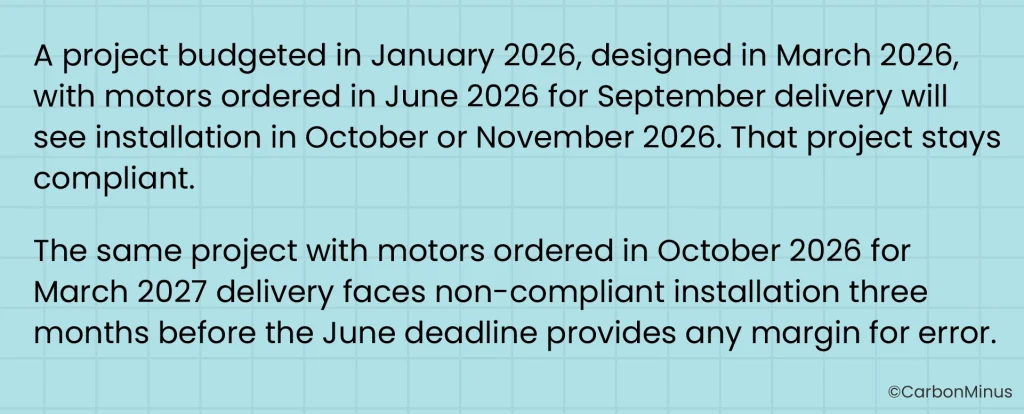
Standard NEMA frame motor procurement takes 6 to 12 months from order to delivery. Custom or large frame motors need 12 to 18 months. Engineering specifications written in Q1 2026 determine whether motors arriving in late 2026 or 2027 meet DOE requirements.
The urgency is not about rushing to buy motors this week. The urgency is about ensuring your 2026 budget accounts for IE4 motor costs instead of IE3 costs, and verifying that engineering standards used for 2026 projects reference post-June 2027 requirements.
Only 100-250 HP Motors Jump To IE4
The DOE rule covers three-phase induction motors from 1 to 750 horsepower. The upgrade requirements concentrate in a specific range.
Motors 1 to 99 HP continue meeting IE3 (NEMA Premium) efficiency with no change. Motors 100 to 250 HP must meet IE4 (NEMA Super Premium) efficiency starting June 1, 2027. Motors 251 to 750 HP continue at IE3 with no change.
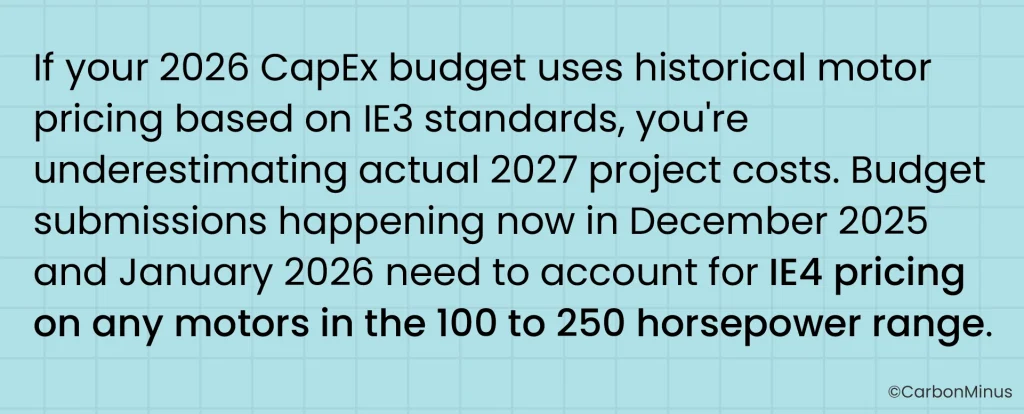
This matters for 2026 budget planning because IE4 motors cost 15 to 25% more than IE3 motors. A 150 HP motor budgeted at $3,500 under IE3 standards will actually cost $4,200 to $4,400 for IE4 compliance. Across 20 motors in your 2026 project pipeline, that’s $14,000 to $18,000 in unbudgeted costs.
The rule applies to single-speed, continuous-duty motors with squirrel-cage rotors on standard NEMA or IEC frames. Liquid-cooled, submersible, synchronous, and inverter-only motors remain exempt.
Audit your facility’s planned 2026 projects. Identify motors in the 100 to 250 horsepower range. Verify budget submissions use IE4 pricing and specifications. Update engineering standards before Q1 2026 design work begins.
The $8.8 Billion Saves More Than It Costs
The DOE projects $8.8 billion in electricity cost savings over 30 years. The rule prevents 92 million metric tons of CO2 emissions. Motors consume 70% of all industrial electricity.
A 100 horsepower motor operating 8,000 hours annually consumes 75 kilowatts at full load under IE3 standards. IE4 reduces consumption to 72.4 kilowatts, saving 2.6 kilowatts. Over 8,000 hours, that equals 20,800 kilowatt-hours saved annually.
At $0.10 per kilowatt-hour, annual savings reach $2,080. The IE4 cost premium of $1,500 to $2,500 delivers payback in 9 to 15 months. IE4 motors achieve up to 97% efficiency versus 95% for IE3 motors, representing 10 to 12% improvement.
This transforms how you present 2026 budget requests. A project requiring five 150 HP motors shows $22,000 in IE4 cost premium versus IE3 baseline. But it also shows $12,500 in annual energy savings starting in 2027. The CFO sees a capital increase that pays back in 21 months and then saves $12,500 annually for 15 years.
The budget justification becomes easier, not harder. DOE compliance is not pure cost, it’s mandated ROI improvement.
| Motor Size | Annual Savings | IE4 Premium | Payback |
| 100 HP | $2,080 | $1,500-$2,500 | 9-15 months |
| 150 HP | $3,120 | $2,200-$3,700 | 8-14 months |
| 200 HP | $4,160 | $3,000-$5,000 | 9-14 months |
VFD Integration During Motor Upgrades
If your 2026 projects include motor replacements or new motor installations, evaluate variable frequency drive integration during the same capital cycle.
VFDs deliver 15 to 40% energy savings on motor loads through speed control matching real-time demand. A 20% speed reduction produces 50% energy reduction due to cube law physics. Payback runs 6 to 12 months.
A 100 HP pump with IE4 motor saves 3.5% versus IE3 baseline. The same motor with VFD saves 30% through speed control. IE4 motor with VFD combines both effects for 32.4% total savings.
Annual savings at $0.10 per kilowatt-hour jump from $2,080 for motor-only to $19,440 for motor plus VFD. The combined approach delivers payback in 8 months versus 12 months for motor-only despite higher initial cost.
For 2026 budget planning, this means evaluating which motor projects justify VFD addition. Variable load applications like pumps, fans, compressors, and conveyors typically warrant VFDs. Constant load applications focus on IE4 motor efficiency alone.
Budget line items for 2026 motor projects should show two scenarios: motor-only compliance and motor plus VFD optimization. The CFO can approve based on complete ROI rather than partial analysis.
2026 Budget Planning Checklist
For Q4 2025 / Q1 2026 Budget Submissions:
Review all 2026 projects including motor purchases or installations. Identify motors in 100 to 250 horsepower range requiring IE4 compliance. Update budget line items with IE4 pricing (15-25% premium over IE3).
Verify engineering standards reference post-June 2027 DOE requirements before Q1 2026 design work begins. Flag projects with motor specifications to ensure they use current standards, not 2023 standards.
Evaluate VFD integration opportunities for variable load applications. Calculate combined ROI for motor plus VFD versus motor-only approach. Present both scenarios in budget justification.
For Q1 2026 Project Design
Ensure all motor specifications for 100-250 HP range reference IE4 (NEMA Super Premium) standards. Request compliance certification numbers on procurement quotes. Update project timelines accounting for motor lead times if custom or large frames involved.
For Mid-2026 Procurement
Verify vendors provide DOE compliance certification with quotes. Confirm nameplates will display certification numbers and IE4 ratings. Schedule delivery with buffer before June 2027 enforcement if installation extends into 2027.
The next 60 days determine whether your 2026 projects have correct specifications and adequate budgets for June 2027 compliance. Budget approvals happening in January 2026 lock in specifications that won’t be questioned until motors arrive 6 to 12 months later.
Why This Matters Now
We’re in the 2026 budget planning cycle. Projects approved in January 2026 budgets get designed in Q1 and Q2 2026. Motors get specified in those designs using whatever standards engineering references at the time. If standards still show IE3 for 100 to 250 HP motors, projects break ground non-compliant.
The DOE rule takes effect June 1, 2027. That’s 18 months away. But 2026 CapEx decisions happening in the next 30 days determine June 2027 compliance status. Waiting until Q4 2026 to think about this means budgets are locked, projects are designed, and procurement is already underway using wrong specifications.
The $8.8 billion in national savings translates to facility-level ROI of 9 to 15 months on motor upgrades. VFD integration multiplies returns to 30 to 40% combined savings. The regulation mandates profit improvement, but only if 2026 budgets account for it.
Update engineering standards now. Revise 2026 budget submissions to reflect IE4 costs. Evaluate VFD opportunities during the same capital cycle. The planning window is open for the next 60 days. After budget approvals in January and February 2026, changing specifications becomes significantly harder.
FAQs
No. Only motors manufactured after June 1, 2027 must meet IE4 standards for 100-250 HP range. Existing installed motors continue operating. However, any motor purchased or installed after June 2027 must be IE4 compliant.
Only for motors in 100-250 HP range. Motors 1-99 HP and 251-750 HP continue at IE3 standards with no change. Focus IE4 cost premiums on the specific range requiring upgrades.
Compliance depends on installation date, not order date. Motors installed after June 1, 2027 must meet IE4 requirements regardless of when ordered. Projects extending into 2027 need IE4 specifications in 2026 budgets.
For 100 HP motors operating 8,000 hours annually, payback runs 9-15 months based on $2,080 annual savings. Adding VFD control reduces combined payback to 8 months through 30-40% total savings.
Review standard specifications for motors 100-250 HP. Replace IE3 (NEMA Premium) references with IE4 (NEMA Super Premium). Add requirement for DOE compliance certification numbers on quotes. Distribute updated standards to engineering and procurement teams before January 2026.